
Beyond the Cecil
Every person has a story.

When people think about our work, they often think about the Hotel Cecil. That makes sense. The Cecil has been home for much of our ministry over the last four years. It’s where we learned that the most effective outreach doesn’t begin with a clipboard or a checklist. It begins with a conversation.
By late 2025, though, it became clear that the need extended far beyond one building. The City of Angels is filled with communities where people are living outside, isolated, forgotten, or simply overwhelmed by circumstances. In December 2025, we made the decision to take what we had learned at the Cecil and bring it into other parts of Los Angeles.
Westlake became one of our first stops.
Since then, we’ve helped connect a dozen people with housing. We’ve distributed comfort care supplies to countless others. Our volunteer medical team has treated wounds ranging from everyday street injuries to the devastating effects of xylazine-related necrosis. For many of the people we meet, walking into an emergency room simply isn’t realistic. Fear, untreated mental illness, drug-induced paranoia, outstanding warrants, or years of difficult experiences with institutions often keep people away from traditional healthcare. Sometimes, the care we provide on a sidewalk or park bench is the only medical attention they receive. Every walk brings another opportunity to listen, to care, and sometimes, to change the course of someone’s life.
One of those lives belongs to James.
We met James early in our walks through Westlake. There was something about him that drew me in. As we got to know one another, he shared pieces of his story. Eventually, we offered him interim housing.
He said yes.
But every time we arranged to meet, he would disappear. Sometimes I would leave to get my car, only to come back and find him gone. Other times he vanished for weeks at a time. It would have been easy to become frustrated or assume he wasn’t serious.
Instead, we waited.
We never scolded him. We never shamed him. We simply kept showing up. We encouraged him. We reminded him that the offer still stood.
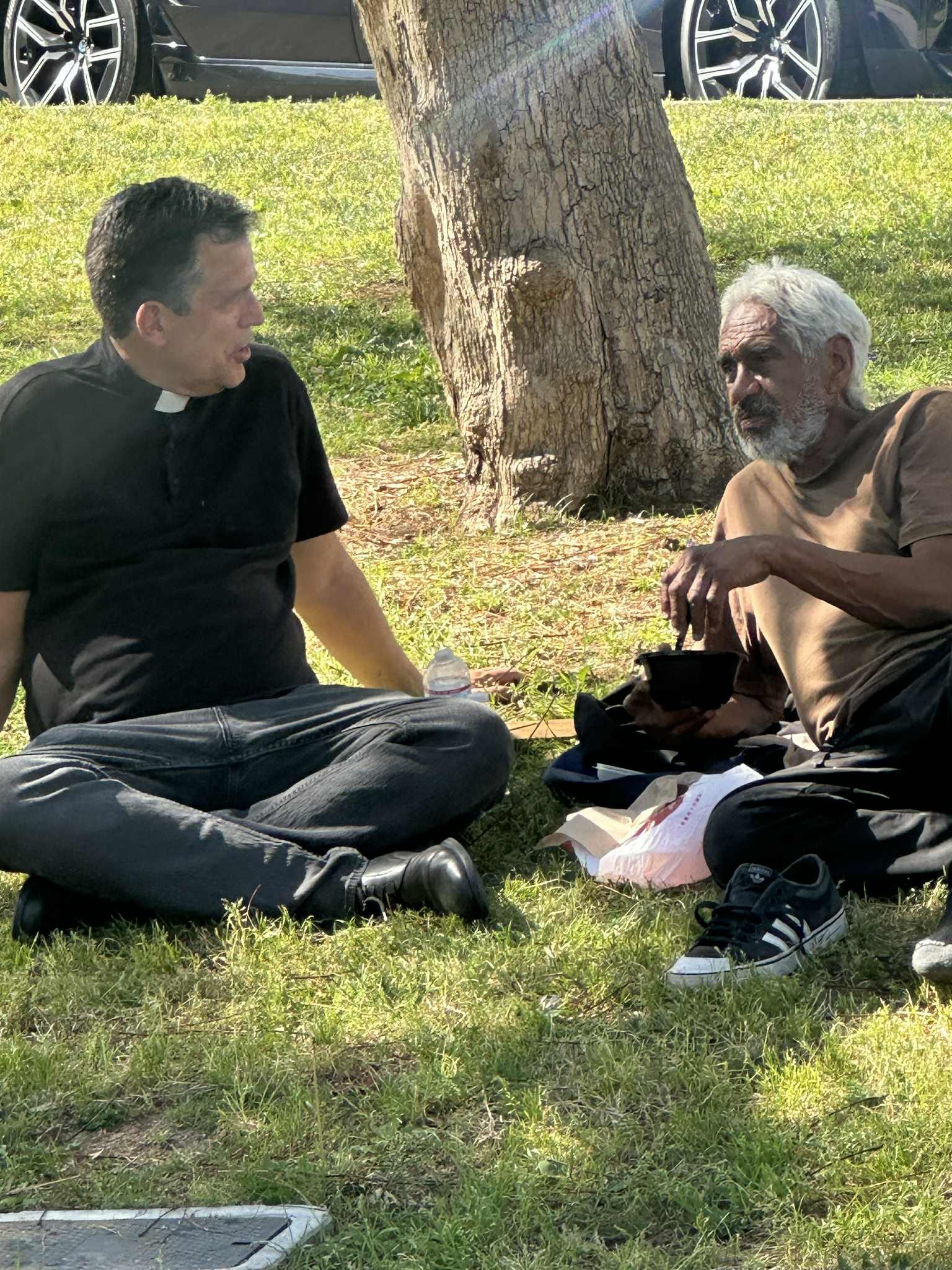
Nearly three months after that first conversation, James stayed long enough for us to get him into the car and to the interim housing program.
Today, he has a roof over his head.
Not because we had a better program than everyone else.
Because we had a relationship.
A few weeks ago, I met Edna at El Pueblo. We’d crossed paths before, but this time we slowed down. We learned each other’s names. I bought her lunch, and over the course of a meal she shared how she had ended up living outside.
The next day, one of our volunteer case managers met with her.
What we discovered surprised all of us.
Edna had already been matched with housing.
Somewhere along the way, the process had stalled. Now we’re working to find out why. Our hope is that within days—not months or years—Edna will finally have a place to call home.
Sometimes the biggest obstacle isn’t the absence of resources.
It’s the absence of someone willing to walk alongside another person long enough to connect all the dots.
That has become one of the defining lessons of this ministry.
The people we meet are not statistics. They are not “the unhoused.” They are not case numbers, performance metrics, or quarterly reports.
They are neighbors.
Each one has a name. Each one has a history. Each one carries trauma, hope, disappointment, resilience, and dreams that are every bit as real as our own.
I believe most agencies begin with good intentions. They hire compassionate people who genuinely want to help. But somewhere along the way, the work often becomes driven by metrics, funding requirements, and the need to demonstrate outcomes. People become numbers. Success is measured in spreadsheets instead of relationships.
That’s where we try to be different. We don’t begin with the paperwork. We begin with the person. We spend the time to learn names, hear stories, understand fears, and earn trust. Ironically, it’s often those relationships that lead to the very outcomes everyone is trying to measure.
Relationships rarely fit neatly into a spreadsheet.
You can’t quantify trust on a dashboard. You can’t chart the moment someone decides, after months of fear, that they’re finally ready to accept help. You can’t reduce hope to a spreadsheet.
Yet those moments are often where real change begins.
That’s why we do this work the way we do.
We slow down.
We learn names.
We hear stories.
We earn trust.
Only then do we begin looking for solutions, because the solutions are rarely one-size-fits-all. Every person arrives carrying a different story, and every story deserves to be heard before we try to write its next chapter.
The work beyond the Cecil has reminded me of something I first learned there years ago: people don’t need to be fixed nearly as much as they need to be known.
Once that happens, remarkable things become possible.
Help us continue this vital work.
Every gift helps us continue providing outreach, street medicine, comfort care, and housing advocacy throughout Los Angeles.